
Background
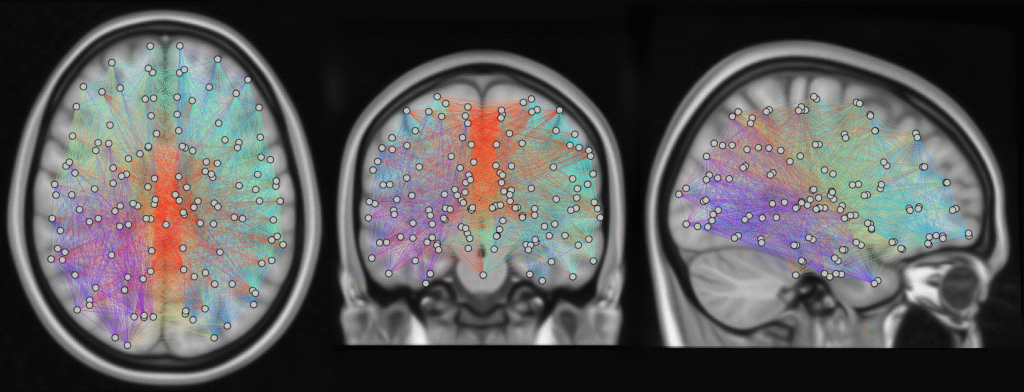
Community detection in graphs aims at finding the best partitioning. Real-world networks (e.g. the human brain), however, tend to describe asymmetric and directed relationships, but community detection methods have not yet reached consensus on how to define and retrieve communities in this setting. The newly proposed Bimodularity frameworks answers this long-standing question by updating the definition of Modularity and the spectral graph clustering approach. Please contact us for more details.
Project description
This is preferably a Master Thesis project but could be investigated in a semester project. It is predominantly theoretical and computational with promising application in network neuroscience.
Requirements
- The applicants are expected to have knowledge in signal processing.
- Good programming skills is required. Python is preferred but at least being comfortable in one programming language is required.
- Desired: Travel to Geneva 1 day per week.
References
- Cionca, Alexandre, Chun Hei Michael Chan, and Dimitri Van De Ville. “Community detection for directed networks revisited using bimodularity.” Proceedings of the National Academy of Sciences 122.35 (2025): e2500571122.
- Malliaros, Fragkiskos D., and Michalis Vazirgiannis. “Clustering and community detection in directed networks: A survey.” Physics reports 533.4 (2013): 95-142.
- Fortunato, Santo, and Darko Hric. “Community detection in networks: A user guide.” Physics reports 659 (2016): 1-44.