
Master Project – Spring 2026
Background
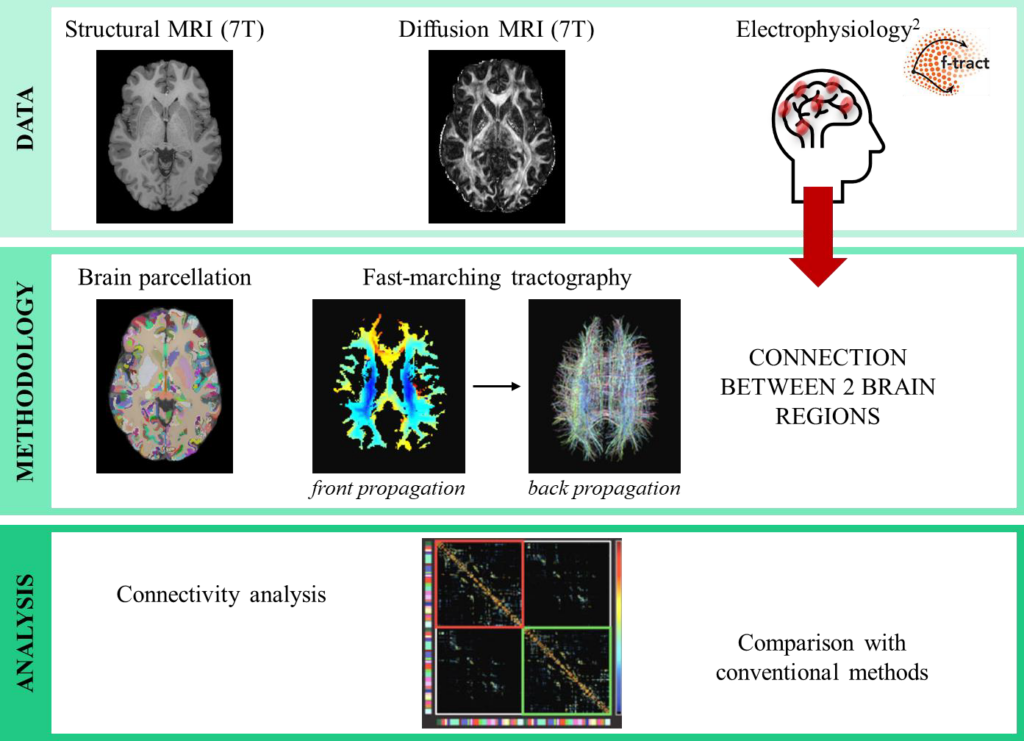
Modern neuroscience increasingly understands brain architecture as a dynamic network that underlies structural and functional connectivity between brain regions. Connectomics offers a sound framework for representing complex brain data in both healthy and pathological conditions [1]. The reconstruction of white matter pathways, usually indirectly inferred from diffusion magnetic resonance imaging, relies on the modelling of the signal that arises from the diffusion of water molecules within the brain. As such, its reliability could highly benefit from combining information obtained from various, complementary modalities.
Project description
We propose an original approach that consists in estimating a tractogram from in vivo, intracerebral electro-physiological recordings in 613 adult patients suffering from pharmaco-resistant focal epilepsies [2]. A probabilistic atlas of anatomo-functional connectivity of the human brain will serve as an a priori for mapping structural connectivity between two brain regions using a fast-marching tractography algorithm [3] transposed to high-resolution, multi-shell diffusion MR images acquired at 7T (n=40).
Requirements
- Background in electrical engineering, biomedical engineering, physics, or related field.
- Proficiency in programming is mandatory (e.g., Python, bash). Experience with typical neuroimaging software is a plus.
- Rigour is a must. Curiosity, creativity, and sense of initiative are very welcome.
- Excellent written and oral communication skills in English and/or French.
Please contact Hélène Lajous (helene.lajous@chuv.ch) with your CV and a brief statement of research interests.
Starting from: February 2025.
A more detailed description of the project can be found here.
References
[1] The human connectome: A structural description of the human brain. Sporns et al., PLoS Computational Biology (2005). https://doi.org/10.1371/journal.pcbi.0010042
[2] A brain atlas of axonal and synaptic delays based on modelling of cortico-cortical evoked potentials. Lemaréchal et al., Brain (2022). https://doi.org/10.1093/brain/awab362
[3] Estimating distributed anatomical connectivity using fast marching methods and diffusion tensor imaging. Parker et al., IEEE Transactions on Medical Imaging (2002). https://doi.org/10.1109/IEMBS.2007.4352288